
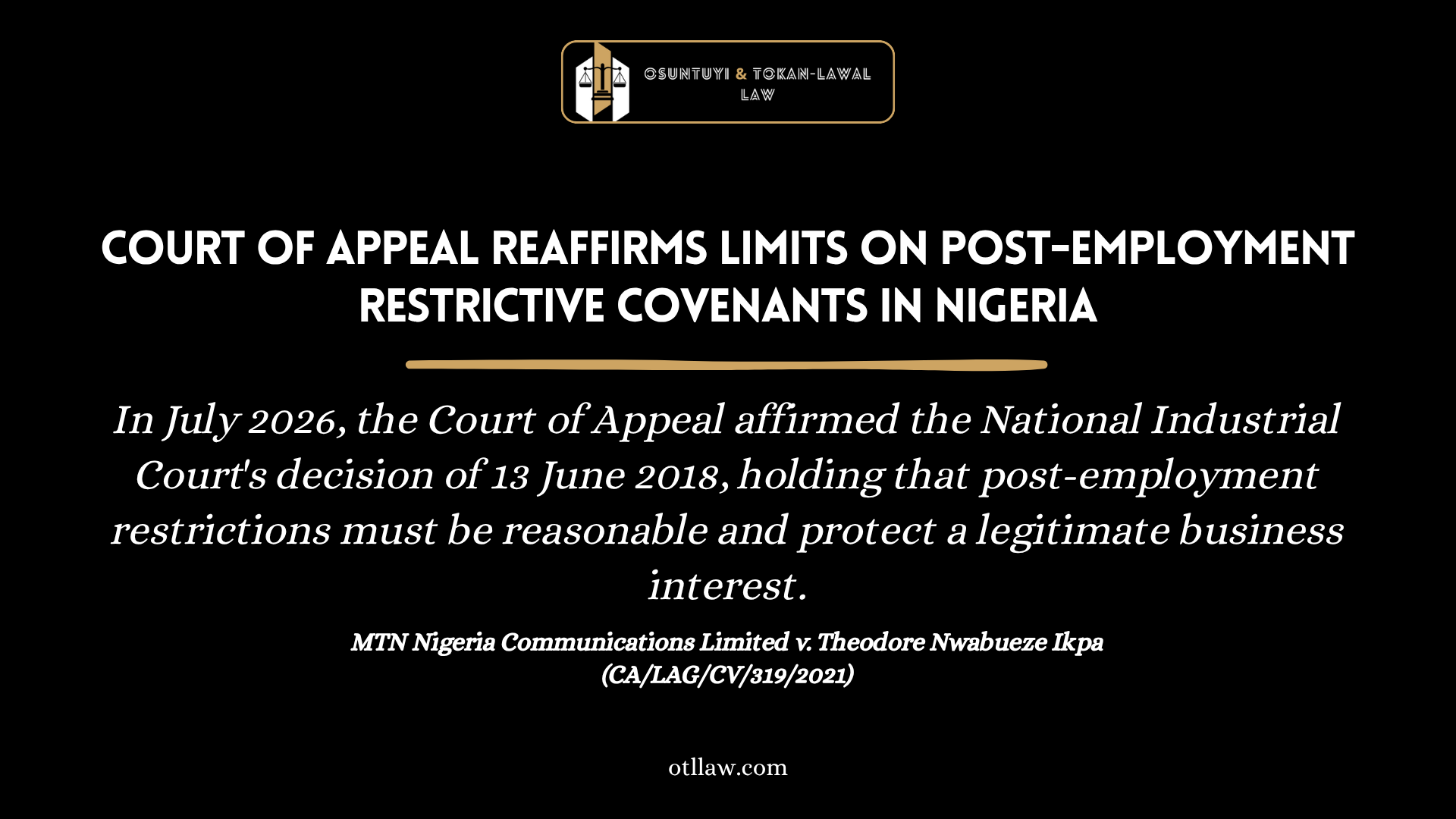
A July 2026 decision of the Court of Appeal, Lagos Division, reinforces an important principle of Nigerian employment law: while employers are entitled to protect their legitimate business interests, they cannot impose unreasonable restraints on a former employee’s ability to earn a living.
In MTN Nigeria Communications Limited v. Theodore Nwabueze Ikpa (CA/LAG/CV/319/2021), the Court of Appeal dismissed MTN’s appeal, thereby upholding the decision of the National Industrial Court delivered on 13 June 2018.
The decision provides timely guidance on the enforceability of post-employment restrictive covenants, reaffirming that such restrictions will only be upheld where they are reasonable and necessary to protect a legitimate business interest.
What does this mean for employers?
The judgment is not a blanket prohibition on post-employment restrictive covenants. Employers remain entitled to protect confidential information, trade secrets, customer relationships, goodwill and other proprietary business interests after an employee leaves.
However, any post-employment restriction must be reasonable in its duration, scope and geographical reach, and no wider than is necessary to protect the employer’s legitimate business interests.
Employers should therefore review broad, standard-form non-compete provisions that seek to prevent former employees from working across an entire industry or for lengthy periods. Restrictive covenants should instead be carefully tailored to protect identifiable business interests, with particular emphasis on appropriately drafted confidentiality, non-solicitation and non-dealing obligations where necessary.
And for employees?
Employees should not assume that signing a restrictive covenant means they have permanently surrendered their ability to pursue future employment. Equally, the decision should not be interpreted as a licence to disregard contractual obligations.
Whether a restrictive covenant is enforceable will depend on its particular wording, duration, scope, purpose and practical effect. Employees who are subject to post-employment restrictions should therefore seek legal advice before joining a competitor or establishing a competing business.
Looking ahead
The Court of Appeal’s decision reinforces the careful balance at the heart of employment law: businesses are entitled to protect their legitimate commercial interests, but employees should not be subjected to restrictions that unreasonably prevent them from earning a living.
The decision also serves as a timely reminder that the enforceability of a restrictive covenant depends not on the label attached to it, but on whether it is reasonable and proportionate in the circumstances. Employers should therefore review existing employment contracts to ensure that post-employment restrictions are carefully drafted, commercially justified and capable of withstanding judicial scrutiny.