
Introduction
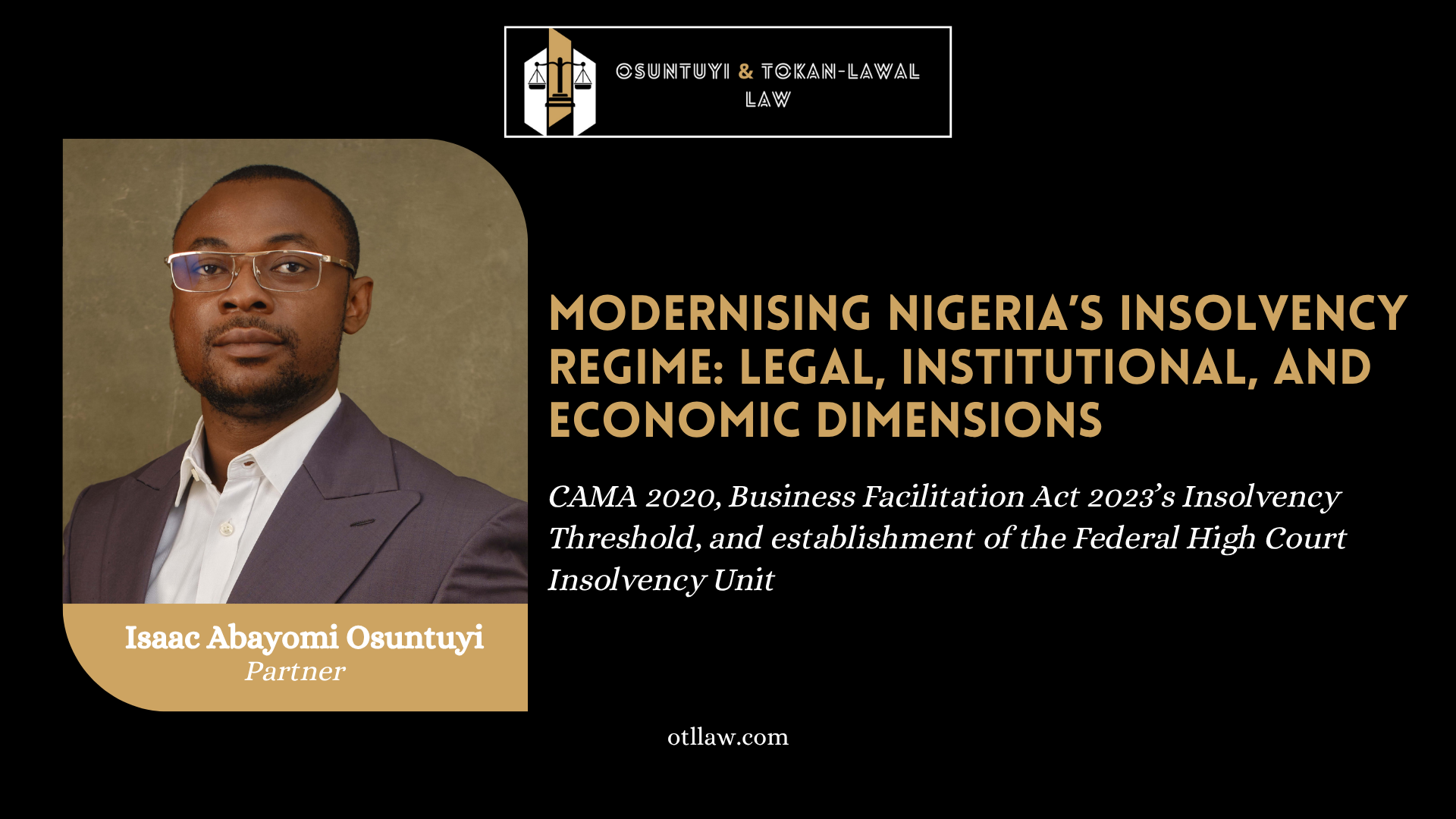
Nigeria’s insolvency regime has undergone transformative changes in recent years, responding to systemic economic stress among businesses, regulatory reforms, and institutional innovation. This article examines key recent developments; including the evolution of statutory law under the Companies and Allied Matters Act (CAMA) 2020, the Business Facilitation Act 2023’s insolvency thresholds, and the establishment of a Federal High Court Insolvency Unit to explore how Nigeria is modernising its insolvency and corporate rescue framework.
Legal Reforms in CAMA 2020 and the Administration Mechanism
For the first time, under section 444 of the CAMA, Nigeria officially introduced administration as a corporate rescue mechanism, along with traditional liquidation and winding-up procedures. The paradigmatic change places Nigeria alongside global best practices by introducing a mechanism to keep struggling companies alive and to maximise the returns to creditors, as opposed to immediate liquidation on the occurrence of insolvency.
Despite its promise, administration as a tool remains underutilised for various reasons. These include, ignorance among stakeholders, reluctant creditors, and impatient interested parties. Awareness campaigns, training of insolvency practitioners and legal professionals, and periodic stakeholder sensitisation will be required to increase its use.
Business Facilitation Act 2023 and Cash‑Flow Insolvency Thresholds
The Business Facilitation (Miscellaneous Provisions) Act 2023 is another landmark. The Act was part of the Federal Government’s ease-of-doing-business agenda. One of the most notable of its reforms was the abolishment of the hitherto ₦200,000 cash-flow insolvency test under the old CAMA regime. The rationale for the abolishment was to allow a more flexible and economically relevant threshold to be decided via future regulation by the Corporate Affairs Commission (CAC).
But to date, no public record is available that the CAC has issued such regulations, and the threshold of insolvency is left undefined. This lack of regulation triggers uncertainty and poses two serious concerns. First, creditors may make insolvency petitions arbitrarily as a means of harassing solvent companies for small debts. Second, genuinely insolvent companies would be unrestrained to carry on free from interference, creating “zombie businesses” that drain market resources and public faith.
More positively, the Business Facilitation Act also amended section 658(6) of CAMA 2020 to define the expression “fraudulent preferences.” More specifically, it provides that any transaction with an associate (e.g., directors or their immediate family) in the two years preceding the onset of insolvency may be set aside if it is established to be preferential. This amendment corrects an otherwise uncertain provision and brings Nigerian law closer to international standards on related-party transactions and pre-insolvency transfers of assets.
Creation of Insolvency Unit within the Federal High Court
A major institutional breakthrough in March 2025: the Federal High Court set up a specialised Insolvency Unit. The unit was established to supervise all corporate reorganisation and winding-up processes under CAMA 2020, the Asset Management Corporation of Nigeria Act 2019 (AsAamended), the Nigeria Deposit Insurance Corporation Act 2024, and the Bankruptcy Act 2010. The unit is committed to streamlining administration, company voluntary arrangements, receivership, and dissolution, introducing world-best-practice standards: faster, transparent, and expert-led insolvency proceedings. This promises to check protracted litigation, enhance creditor recoveries, and enhance investor confidence by making things more predictable and bringing institutional competence.
Wider Economic Interests and Challenges
The institutional and regulatory reforms are on top of a wider economic crisis: in 2023, Nigeria lost hundreds of manufacturers to distress. According to data from the Manufacturers Association of Nigeria, 767 firms closed down and 335 entered distress, leaving ₦350 billion of unsold inventory. That sectoral collapse is why good mechanisms for debt recovery and corporate restructuring matter. But operationalising reforms is hindered by: under‑development of capacity among insolvency practitioners, court delays, possible manipulation of thresholds, and low levels of public awareness. Without proper regulation surrounding thresholds, firms might inadvertently experience insolvency onset, while creditors would not have faith in voluntary arrangements. Strong enforcement, timely regulation, and capacity building are hence critical.
Conclusion
Nigeria’s insolvency landscape is undergoing substantive reform and legislative rebirth via CAMA 2020, threshold reform via the Business Facilitation Act 2023, and institutional innovation via the Insolvency Unit of the High Court. These measures, if rigorously enforced, can transform Nigeria’s potential for the rescue of companies, creditor protection, and investor confidence. It is, however, the regulation clarity, practitioner training, judicial commitment, and stakeholder sensitisation that must be delivered for this promise to be fulfilled.