
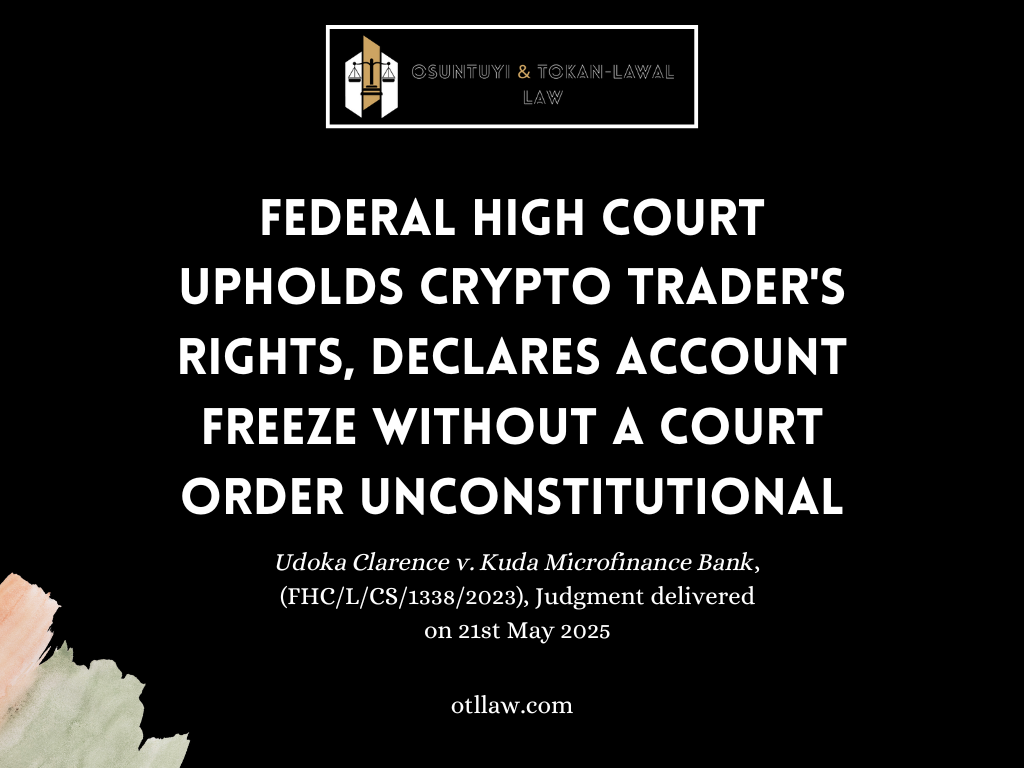
Case Summary
Parties: Udoka Clarence v. Kuda Microfinance Bank
Suit No.: FHC/L/CS/1338/2023
Court: Federal High Court, Lagos Judicial Division
Date of Judgment: 21 May 2025
Presiding Judge: Hon. Justice F.N. Ogazi
Background
Udoka Clarence (“the Plaintiff”), a verified cryptocurrency trader and account holder with Kuda Microfinance Bank (“the Defendant”), filed an action against the bank for unlawfully restricting access to his account without a court order. The restriction, initiated on 4 March 2023, remained in place for over four months.
The Plaintiff sought declaratory reliefs that the restriction was unconstitutional and a breach of the bank’s duty of care. He also requested an order lifting the lien, ₦500,000 in general damages, ₦50,000 in costs, and post-judgment interest at 21%.
The Defendant defended its actions on the basis of a fraud complaint by Flutterwave Technologies alleging a suspicious inflow of ₦3.4 million. It cited its internal terms and conditions and the CBN circular of 5 February 2021 banning cryptocurrency transactions. The Defendant further argued that Flutterwave was a necessary party, and the suit could not proceed without it.
Plaintiff’s Position
The Plaintiff maintained that the restriction was imposed without a valid court order, infringed on his constitutionally protected right to property under Sections 43 and 44 of the 1999 Constitution, and that cryptocurrency trading is not illegal under Nigerian law. He supported his claims with Binance transaction records, USDT receipts, and formal demand letters sent to the Defendant.
Defendant’s Defense
The Defendant claimed the account restriction was in response to a fraud alert from Flutterwave and was justified under its terms and conditions, as well as CBN’s 2021 circular banning cryptocurrency-related transactions. It also argued that Flutterwave was a necessary party whose absence deprived the court of jurisdiction.
Court’s Findings and Analysis
Jurisdiction and Parties: The Court held that Flutterwave was not a necessary party, as it was the Defendant who imposed the restriction and owed the duty to justify it. The bank could not rely on a third-party complaint to escape scrutiny.
Legality of the Restriction: The Court reaffirmed that funds in a bank account qualify as “property” under the Constitution. By law, a bank may restrict access to an account for up to 72 hours without a court order. Any restriction beyond that period without judicial authorisation is unlawful. The Defendant’s own email requesting court approval for an extension was taken as evidence that it was aware of this legal limit. Furthermore, the Court held that contractual clauses allowing banks to freeze accounts unilaterally were unenforceable under the CBN Consumer Protection Regulations.
Evolving Regulatory Landscape: The Court noted that the 2021 CBN ban on crypto transactions was lifted by circular dated 22 December 2023 and titled, FPR/DIR/PUB/CIR/002/003 – Guidelines to all Banks and Other Financial Institution – Guidelines on operations of Bank Accounts for Virtual Assets Service Providers (VASPS). The Defendant was obligated to comply with the CBN order was unlawful. In addition, the Investments and Securities Act 2025 now legally recognises digital assets. Therefore, any reliance on the earlier ban after December 2023 was unjustified.
Breach of Dispute Resolution Guidelines: Kuda also failed to comply with CBN Circular BPS/DIR/GEN/CH/05/011 of 2013, which mandates that banks resolve complaints and liaise with the Nigeria Inter-Bank Settlement System (NIBSS) within two weeks. The Court held that Kuda breached this regulatory obligation.
Judgment
The Court entered judgment in favour of the Plaintiff and held as follows:
– The restriction on the Plaintiff’s account beyond December 23, 2023 was unlawful.
– Kuda Microfinance Bank was ordered to immediately lift the restriction.
– ₦200,000 was awarded as general damages.
– Post-judgment interest at the rate of 10% per annum was granted from May 31, 2025.
– No costs were awarded.
Conclusion
This decision reaffirms the constitutional protection of customers’ funds and establishes that Nigerian banks cannot indefinitely restrict access to accounts without valid court order. The judgment further signals Nigeria’s regulatory shift towards acceptance of cryptocurrency and limits banks’ reliance on outdated circulars , unconscious contract provisions, or broad internal terms to restrict customer rights.